• Home
  • Shop
    • Oscillators
    • VCFs & VCAs
    • Envelope Generators
    • LFOs + Noise
    • Other synth parts
    • Stomp Boxes
  • Articles
    • Projects
    • Synth DIY
    • Stompbox stuff
    • Vintage synths
    • RC Filter Calculator
  • About Us
  • Contact
Skip to content
  • Home
  • Shop
    • Oscillators
    • VCFs & VCAs
    • Envelope Generators
    • LFOs + Noise
    • Other synth parts
    • Stomp Boxes
  • Articles
    • Projects
    • Synth DIY
    • Stompbox stuff
    • Vintage synths
    • RC Filter Calculator
  • About Us
  • Contact

Category: Synth DIY

Voltage Controlled Looping Envelope Generator

Posted on November 3, 2013March 25, 2020

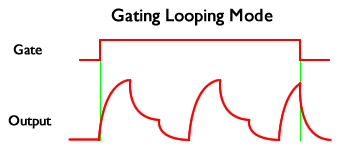
This project is a development of my earlier VCADSR envelope generator. Whilst that chip had both GATE and TRIGGER inputs, this chip replaces the TRIGGER input with a MODE CV that allows selection of normal ADSR, Gated looping, or full LFO-style Looping modes. Standard ADSR mode generates the shape you expect, and allows CV control […]
Posted in Envelope Generators, Projects, Synth DIY   7 Comments on Voltage Controlled Looping Envelope Generator

Voltage-controlled digital oscillator VCDO1

Posted on November 3, 2013February 7, 2026

A single chip 1V/Oct voltage controlled digital oscillator, with 20 waveforms in a scannable wavetable. The VCDO uses a PIC 16F1847 microprocessor to create a versatile and simple voltage-controlled 8-bit digital wavetable oscillator. All oscillator parameters are controlled by 0-5V control voltages. The chip has a native exponential control response, making interfacing with 1V/Oct control […]

Posted in Projects, Synth DIY   58 Comments on Voltage-controlled digital oscillator VCDO1

Tap Tempo LFO (TAPLFO V2D)

Posted on May 8, 2012March 25, 2020

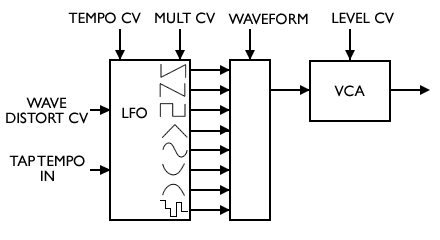
2018 Note: Obsolete! This chip has been superseded by the TAPLFO 3 The new chip adds several features, has additional waveforms and improved resolution, and also no longer requires a crystal. It’s an improvement in pretty much every way! Head over and check out the data sheet. This simple Tap Tempo LFO is based on the […]

Posted in Projects, Synth DIY   29 Comments on Tap Tempo LFO (TAPLFO V2D)

Moog 911 ADSR Envelope Generator clone

Posted on February 22, 2010March 4, 2016

A clone of a classic using my PIC code by J-P Desrochers Jean-Pierre Desrochers wanted to copy the response of the Moog 911 envelope generator using more modern technology. He asked me if it would be possible to tweak the response of my PIC envelope generator to do this, and I told him that it […]

Posted in Envelope Generators, Projects, Synth DIY   Leave a Comment on Moog 911 ADSR Envelope Generator clone

White Noise Source for MM5837 / MM5437 replacement

Posted on September 29, 2009May 21, 2024

A pure white audio noise generator using an 8 pin PIC 12F675 This pages describes a simple digital noise source that produces pure white noise over the whole audio band – out to more than 40Khz, in fact. With filtering, you can derive pink noise and other colours. The circuit diagram included below was developed […]

Posted in Noise, Projects, Synth DIY   19 Comments on White Noise Source for MM5837 / MM5437 replacement

Practical LFSR random number generators

Posted on May 21, 2009July 18, 2025

The linear feedback shift register is one of the most useful techniques for generating psuedo-random numbers. I’ve used this method for creating noise generators and as an element in the random modulation generators I spent a long time developing for my Protowave synth. If you’re not really clear how an LFSR works, have a look […]

Posted in Noise, PIC/Programming, Synth DIY   11 Comments on Practical LFSR random number generators

Voltage Controlled ADSR Envelope Generator (VC ADSR 7B)

Posted on July 20, 2008February 26, 2024

A CEM 3312 / SSM 2056 clone using cheap PIC microprocessors This page describes a cheap clone of the CEM 3312 and SSM 2056 voltage-controlled envelope generator chips. Both of these chips include voltage control of A, D, S and R, but both include other inputs too. The CEM 3312 chip has a input which […]

Posted in Envelope Generators, Projects, Synth DIY   48 Comments on Voltage Controlled ADSR Envelope Generator (VC ADSR 7B)

Envelope Generator – Some notes on the code

Posted on July 11, 2008August 11, 2022

The code follows the same general principles as the LFO, in that it divides into two sections. The main code loop polls each of the A/D channels in turn (one channel per time round the loop) and then does something with the value that was read. The values are not used directly, but instead are […]

Posted in Envelope Generators, PIC/Programming, Synth DIY   Leave a Comment on Envelope Generator – Some notes on the code

CEM3320 Filter designs

Posted on July 1, 2008November 12, 2018

Like my SSM2044 page, this page is a look at how various synths implemented the CEM3320 filter, with the datasheet design as a reference standard. Whereas the SSM2044 is a dedicated lowpass filter, the CEM3320 is just a set of filter building blocks. In this respect, it is more like the earlier SSM2040. The CEM […]

Posted in Elka, Filters, OB-Xa, Oberheim, Pro-One, Sequential, Synth DIY, Synthex   51 Comments on CEM3320 Filter designs

SSM2044 LP Filter designs

Posted on June 18, 2008March 5, 2018

This page is a look at how various synths implemented the SSM2044 filter, with the datasheet design as a reference standard. I’ve redrawn all the schematics to make comparisons very easy. First, the datasheet design.   The datasheet suggests using the two differential inputs (+audio and -audio) as individual oscillator inputs for a two-oscillator synth […]

Posted in Filters, Korg, MonoPoly, Opera, Polysix, PPG, Siel, Synth DIY, Trident, Wave   12 Comments on SSM2044 LP Filter designs

Posts navigation

Older posts
Newer posts

Electric Druid

All Rights Reserved.

Comments & Feedback

If you’ve got comments, queries, or problems, please contact us. We’d love to hear your feedback about the site, our chips, and your ideas for new stuff!

Shipping

Read about our shipping policy here

Personal use

Druid code and schematics are released under a CC BY-NC-SA 4.0 license, so feel free to download and use Electric Druid code in your personal synth, pedal, or sonic blastertron 2000. Grab a copy of the schematics and tweak away to your heart’s content. If you don’t have a PIC programmer, you can order a chip from the shop. Check the legal stuff for more details.

Commercial use

Electric Druid code and schematics are released under a CC BY-NC-SA 4.0 license. Please check the legal stuff for more details. If you’d like to use Electric Druid chips, code, or circuits in your commercial product, we’d ask that you buy chips from us to help support the development of further projects. We can supply programmed, labelled chips in whatever quantities you need. If this isn’t suitable, please contact us to discuss your requirements. Thanks!