
The linear feedback shift register is one of the most useful techniques for generating psuedo-random numbers. I’ve used this method for creating noise generators and as an element in the random modulation generators I spent a long time developing for my Protowave synth. If you’re not really clear how an LFSR works, have a look […]
Articles
A CEM 3312 / SSM 2056 clone using cheap PIC microprocessors This page describes a cheap clone of the CEM 3312 and SSM 2056 voltage-controlled envelope generator chips. Both of these chips include voltage control of A, D, S and R, but both include other inputs too. The CEM 3312 chip has a input which […]
The code follows the same general principles as the LFO, in that it divides into two sections. The main code loop polls each of the A/D channels in turn (one channel per time round the loop) and then does something with the value that was read. The values are not used directly, but instead are […]

Like my SSM2044 page, this page is a look at how various synths implemented the CEM3320 filter, with the datasheet design as a reference standard. Whereas the SSM2044 is a dedicated lowpass filter, the CEM3320 is just a set of filter building blocks. In this respect, it is more like the earlier SSM2040. The CEM […]

This page is a look at how various synths implemented the SSM2044 filter, with the datasheet design as a reference standard. I’ve redrawn all the schematics to make comparisons very easy. First, the datasheet design. The datasheet suggests using the two differential inputs (+audio and -audio) as individual oscillator inputs for a two-oscillator synth […]
This page is intended to be a look at some of the key technical aspects of the B3 Hammond organ that contribute to the “Hammond sound”. My personal slant is towards copying this sound using other technology. Perhaps one day I’ll build a “clonewheel” organ, but then again, Clavia might have nailed it! Still, building […]
This voltage-controlled LFO is based on the PIC 16F684, which is a pretty basic chip. Nonetheless, this LFO has more features than your average LFO. For a start, it can produce 7 basic waveforms, and also includes a noise source. It can also morph its waveforms under CV control, well beyond basic PWM. There is […]
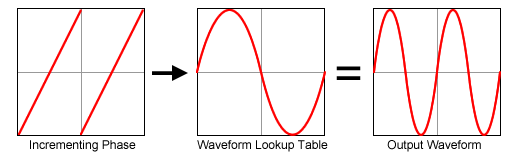
Direct digital synthesis is a common technique for generating waveforms digitally. The principles of the technique are simple and widely applicable. You can build a DDS oscillator in hardware or in software. A DDS oscillator is sometimes also known as a Numerically-Controlled Oscillator (NCO). How does it work? The most important part of a DDS […]
I heard about this and could find little about it, so I started to investigate. Phase Distortion is one of those forgotten synthesis techniques that someone once built a few instruments with, and then abandoned. In the case of PD, Casio were unlikely synth pioneers to start with, and after a brief flirtation they gave […]

This page is an overview of two techniques for creating wavetable oscillators. Contents DDS – Korg DW series and similar Variable sample rate – PPG Wave and similar DDS – Korg DW series and similar The Korg DW series use a DDS oscillator scheme. Korg called it ‘DWGS’ for ‘Digital Waveform Generator System’ in the 80’s style […]